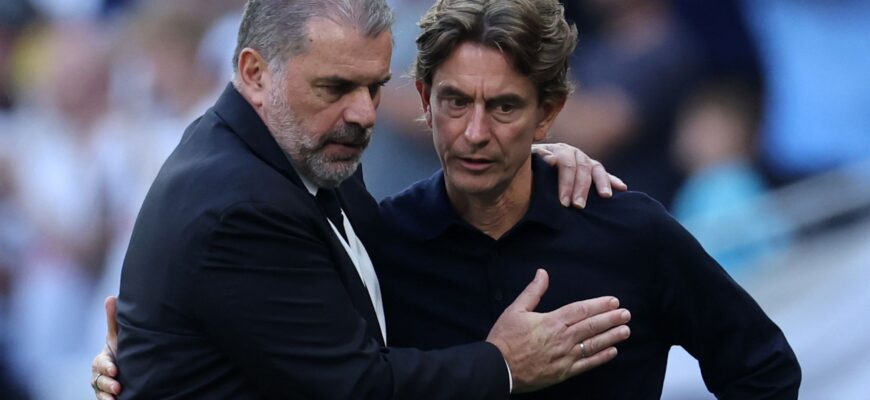
When Thomas Frank first took the helm at Championship club Brentford, the prospect of managing one of football`s wealthiest teams and competing in the UEFA Champions League likely seemed a distant dream. Yet, insights shared by Frank six years ago about his managerial philosophy provide a clear rationale for his widely reported imminent move to Tottenham Hotspur.
“As a person, I`m very open, very human-minded,” Frank stated in a 2019 interview. “That`s one side. The other is my love for football details. I want to develop a specific style of play, to create an attractive game, but I`m equally focused on cultivating a fantastic culture and environment. I was fortunate to be at a club keen on achieving both.”
This balanced approach serves as a compelling pitch for any managerial candidate, but Frank`s philosophy appears particularly well-suited for Spurs. The club recently parted ways with Ange Postecoglou after a season marked by contradictions. Postecoglou delivered a long-awaited trophy, ending a 17-year drought, but the team also finished 17th in the Premier League, a key factor in his departure. While partly influenced by persistent injuries, this poor league finish highlighted weaknesses Tottenham must address to succeed domestically and in European competition next season.
A critical area for improvement under a new manager is the playing style. Postecoglou rigidly adhered to his attacking, high-line strategy, a method that was undeniably entertaining but often left the team defensively vulnerable. Frank`s potential hiring seems a direct response to this vulnerability. While he also favors an attacking style common among modern managers, he operates with greater pragmatism. Over his seven seasons at Brentford, including four in the Premier League, he has adapted his tactical setup, employing formations like 4-3-3, 5-3-2, and most recently 4-2-3-1 based on available personnel.
Frank could also significantly improve Tottenham`s specific weakness in defending set pieces. Last season, Spurs conceded 13 goals from set plays, the fifth-worst record in the Premier League, with an expected goals against tally of 14.24, ranking third-to-last. In contrast, Frank`s Brentford conceded just two goals from set pieces last season – the fewest in the league – despite facing an expected goals against of 9.68 from such situations.
Furthermore, Frank is well-equipped to maximize Spurs` offensive capabilities, which were a relative strength last season. Despite their 17th-place finish, Tottenham remained one of the league`s better attacking sides. Brentford, finishing 10th, matched Spurs` offensive output, tying for fifth in goals scored with 66 (two more than Spurs` 64) and ranking eighth in expected goals with 60.21 (slightly ahead of Tottenham`s 59.65).
Frank`s success is built on a detail-oriented approach, fundamentally linked to Brentford`s embrace of data analysis. The club is a prime example of how a data-driven operational model can lead to sustained success, becoming a Premier League fixture since their 2021-22 promotion. Their strategy often involves signing young talents and selling them for significant profit to larger clubs, notably receiving over $35 million each for Ollie Watkins and David Raya from Aston Villa and Arsenal, respectively.
Brentford`s transfer success highlights Tottenham`s significant challenge last season, which wasn`t solely the manager. While strong at full strength, Spurs had squad weaknesses and often lacked inspiring options off the bench. A midfield overhaul is needed after underwhelming seasons from Yves Bissouma and Rodrigo Bentancur, and support is required for the injury-prone James Maddison, currently the team`s only reliable attacking midfielder. Upgrades in the forward line are also necessary; Son Heung-min had a good season but turns 33 soon, limiting his future as the main offensive focal point. Dominic Solanke performed reasonably with 16 goals but could still be upgraded.
This is where a robust data-driven approach could be crucial for Spurs, whose transfer record has been inconsistent. Despite being the ninth-richest club globally, their financial power lags behind direct rivals, making signing established superstars difficult. Identifying and acquiring the next wave of top talent is a more viable strategy, which relies heavily on the team *behind* the manager. This summer is vital for Frank, but arguably more so for Spurs` front office, including technical director Johan Lange and Fabio Paratici, the former managing director expected to return after his ban ends. Their responsibility will be to secure the players Frank needs to fulfil his potential at an elite club.
Frank: The Latest Manager on the Rise
Before Postecoglou`s departure, questions arose about whether Spurs could truly find a superior replacement, given the lack of obvious elite candidates. The club leadership has clearly opted for Frank, who offers a suitable tactical profile despite his limited experience at the very highest level of European competition.
Frank`s only prior European experience was in Europa League qualifiers with Brondby in Denmark (2014-15, 2015-16), without reaching the group stage. His potential move to Spurs reflects a broader trend of managerial transition in football, with established figures like Carlo Ancelotti and Jurgen Klopp stepping back, prompting top clubs to pursue rising talents like Xabi Alonso and Arne Slot. While Frank may not have the same high profile as Alonso or Slot, his impressive work at Brentford has earned him this opportunity at one of the most prominent clubs.
Another key strength attributed to Postecoglou was his exceptional ability to manage players on a personal level. He seemingly never lost the dressing room, even during the team`s slide. The Europa League triumph under him is a testament to how team spirit and intangibles can compensate for tangible shortcomings. The current Spurs squad holds Postecoglou in high regard, with many posting heartfelt tributes after his exit. While it`s unfair to expect Frank to replicate Postecoglou`s unique connection, his stated `no dickheads` policy aligns well with fostering a positive dressing room atmosphere.
“Our culture is built on values like togetherness and hard work,” said Brentford`s Christian Norgaard in 2023. “Thomas always uses the phrase `confident but humble.` He has this no-dickhead policy, which I think we embody. In the changing room, everyone is pulling in the same direction; otherwise, they wouldn`t be here.”
All the necessary components seem present for a Frank-led Tottenham, but the crucial question is how quickly they can coalesce. Postecoglou`s final message emphasized the significance of the Europa League win in changing the narrative and providing a foundation for future success. Living up to that vision, especially with a Champions League campaign ahead, will be a collective effort for the club, not just Frank. Time, and crucially, this summer`s transfer activity, will determine if Spurs are positioned for success in the 2025-26 season. However, as managerial choices go, Frank represents a logical fit for a club that constantly aims to outperform expectations.