
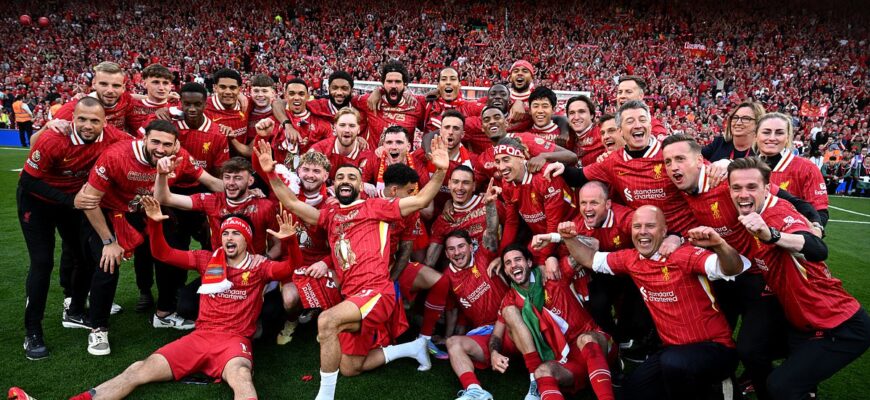
Only three matches remain separating the four semi-finalists from the ultimate glory in European club football. At this advanced stage, past struggles or shaky performances on the path to the semi-finals matter less; there is always a genuine possibility for any of the remaining contenders. Arsenal, Barcelona, Inter, and Paris Saint-Germain all enter this final stage with credible chances, and it seems entirely plausible that one or even all of them could lift the trophy in May.
However, none of these teams are without flaws. Each has lost at least one match in the competition so far. While three-quarters of the teams finished second, third, and fourth respectively in the Champions League group phase, the team that narrowly qualified for the knockout playoffs on the final day is considered just as likely to win as any other. This truly appears to be a remarkably balanced field.
So, what factors might tip the scales for or against these teams? Let`s explore below.
- 1. Arsenal
- Why they will win the Champions League: Defense wins titles
- Why they won`t win the Champions League: Scoring hot streak cools down
- 2. Barcelona
- Why they will win the Champions League: They have exceptional individual talent
- Why they won`t win the Champions League: Their high line is vulnerable
- 3. Inter
- Why they will win the Champions League: Recent experience
- Why they won`t win the Champions League: They don`t create enough quality chances
- 4. Paris Saint-Germain
- Why they will win the Champions League: The press
- Why they won`t win the Champions League: Too many low-quality shots
1. Arsenal
Why they will win the Champions League: Defense wins titles
While another team in the final four, Inter, has conceded fewer goals, no team is more effective at limiting opponent opportunities in front of goal than Arsenal. Across 12 matches, they have restricted opposition shots to an average of 0.69 non-penalty expected goals (npxG) per game. By nearly every statistical measure, Arsenal`s defense is elite. They allow opponents just 16.4 touches per game in their penalty box, almost five fewer than any other remaining team, and concede only 10.3 shots per game. This is impressive, especially considering they recently faced Real Madrid`s formidable attack, which struggled to generate any expected goals against them until a specific defensive error.
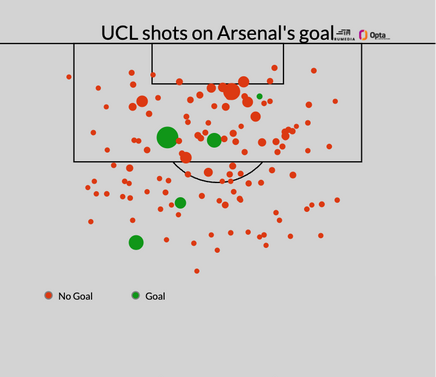
The old saying “defense wins championships” rarely rings truer than in the Champions League. Over the last six seasons, the only club to win the competition while allowing more than one npxG per game is Real Madrid. Only four teams in that period have allowed 0.7 npxG or less; two of them reached the final in 2021, and another was the Manchester City side that missed penalties against Real Madrid in the 2024 quarterfinals. Arsenal`s defensive record puts them in elite company.
Why they won`t win the Champions League: Scoring hot streak cools down
Arsenal is a highly effective side, and like most teams at this stage, it`s easier to make a case for them winning than against it. Beyond a general sense that they might need more experience at this level and minor worries about the absence of a specific type of number nine (concerns less felt since Bukayo Saka`s form improved), there isn`t much obvious negativity. However, a potential concern is that the team has significantly outperformed the quality of chances they`ve created.
Their 22.82 expected goals (xG) have resulted in 30 actual goals. No other team left in the competition has added more shooting goals (the difference between post-shot xG and pre-shot xG). Arsenal has enjoyed a period of exceptional finishing in this competition, including remarkable goals. In the long term, their scoring output should statistically regress closer to their xG, although there`s no guarantee this must happen within the timeframe of the remaining matches. Conversely, this is also a team that has shown it can convert chances worth two-plus xG into zero goals in crucial cup ties. Mikel Arteta will hope that doesn`t occur again.
2. Barcelona
Why they will win the Champions League: They have exceptional individual talent
A sign of Barcelona`s potential is the difficulty in pinpointing just one “best player” I might be referring to. Lamine Yamal? Perhaps too early for that label. Robert Lewandowski? A strong candidate, but fitness is a factor. Pedri? It truly could be him. However, based purely on Champions League output this season, Raphinha stands out. Cristiano Ronaldo holds the record for the most goal involvements in a single season (21 in 2013-14). With potentially three matches still to play, Raphinha is on 19. While he`s had more games to accumulate this tally, it remains an astonishing performance from the former Leeds player.
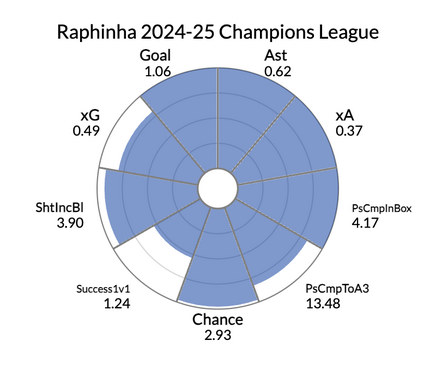
Raphinha not only leads the competition in goal involvements but also in assists and big chances created. Only two opponents faced by Barcelona so far – Monaco and Brest – have prevented him from having a direct impact on the scoresheet. He is nearing legendary club records. Two more goals would equal Lionel Messi`s best European scoring season for the Blaugrana, and two more assists would tie both the club and Champions League record held by Luis Figo. His individual brilliance is a major asset.
Why they won`t win the Champions League: Their high line is vulnerable
Hansi Flick`s approach since taking the Barcelona job has been a bold gamble: implement a highly aggressive, pressing style akin to Bundesliga football with an extremely high defensive line, trusting that intense pressure from forwards and midfielders will prevent the defense from being exposed over the top. For the most part, this has been successful, particularly in La Liga, where its athleticism and intensity have surprised opponents used to a different pace. In the Champions League, however, moments of vulnerability have appeared.
Benfica managed to break down Barcelona by playing long balls and winning second balls. Borussia Dortmund, with speed on the flanks, frequently penetrated the offside trap and might have come even closer to overturning a four-goal deficit if they hadn`t mistimed some of their runs. Barcelona`s defense can be breached. Their backline allows more through balls than any other team remaining in the competition. They have conceded more expected goals from counter-attacks than Arsenal, PSG, and Inter combined. Elite opposition with pace could exploit this vulnerability.
3. Inter
Why they will win the Champions League: Recent experience
A consistent presence in the knockout stages over the past four years, including being beaten finalists in 2023 and putting up strong fights against Liverpool and Atletico Madrid in other campaigns, this Inter squad is highly familiar with the demands of the Champions League. Over the last five years, 13 players in Simone Inzaghi`s squad have accumulated 30 or more appearances in this competition. In contrast, PSG has nine such players, Barcelona six, and Arsenal none. This wealth of experience is a significant advantage.
Inzaghi has benefited from having a stable squad that hasn`t undergone radical changes. Eight of the players who started the final defeat to Manchester City in Istanbul are still with the club; indeed, seven of them were in the starting lineup that drew with Bayern Munich in the quarterfinal. This settled core has made it easier for relatively younger and newer players like Yann Aurel Bisseck and Marcus Thuram to integrate and contribute effectively. This is not a team that seems likely to shy away from the pressure of the crucial matches ahead.
Why they won`t win the Champions League: They don`t create enough quality chances
Unfortunately for Inter, all that experience hasn`t necessarily translated into the statistical profile of a typical Champions League winner so far. While anything can happen when you`re just three games away from the prize, the data suggests they are a step behind the other contenders. A goal difference of plus 14 is respectable, but the fact that they`ve only conceded five goals appears to be partly a result of excellent goalkeeping by Yann Sommer and remarkably poor finishing from opponents. While there might be reasons why top strikers have had off nights against Sommer, relying on this trend to continue against Barcelona`s attack would be risky.
Crucially, Inter`s attack doesn`t look like one capable of consistently winning a major European title. The six penalties they`ve won – four converted – significantly inflate their scoring output. Fifteen non-penalty goals from 12 games is not necessarily the hallmark of future champions, nor is their 1.36 npxG per game. This npxG rate places them exactly in the middle of the 36 teams that started the Champions League. Their npxG difference, at 0.33 per game, is less than half of the third-best team (Barcelona) and ranks them only 11th across the entire competition. While some teams above them faced easier paths, these underlying numbers do not strongly signal Inter as future champions.
4. Paris Saint-Germain
Why they will win the Champions League: The press
By now, you may be familiar with the narrative suggesting a path for Paris Saint-Germain to finally lift the trophy. With their previous “big three” attackers gone, Luis Enrique`s PSG appears to have transformed into a more cohesive unit than seen since the Qatari takeover. This is reflected in a playing style dictated more by the midfield and a fluid, interchangeable attack where players collaborate rather than focusing solely on individual brilliance.
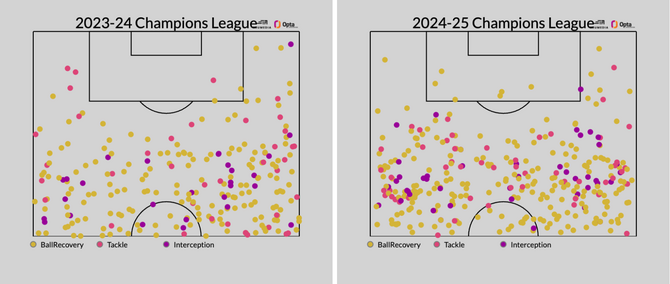
Above all, this new PSG is defined by its performance without the ball. Although the data sample includes two more games this season compared to the previous one, the accompanying image illustrates the significant increase in their ball-winning effectiveness. Few teams press with the intensity and organization of Luis Enrique`s side.
Their 9.2 passes allowed per defensive action (PPDA) is the second lowest in the competition, behind only Bayern Munich. Two years ago, that number was 13.5. No team in the entire competition averages more ball recoveries in the front two-thirds of the pitch than the French champions, who regain possession 31.1 times per game. According to Wyscout data, no team wins more defensive duels. Their aggressive defensive work is a powerful weapon.
Why they won`t win the Champions League: Too many low-quality shots
Similar to Arsenal, there isn`t an extremely obvious, glaring flaw in PSG`s profile (though Barcelona arguably has one, it doesn`t make them less likely to win than the others). Like any team, injuries in key positions could derail them, particularly at center forward or full-back. Assuming full fitness, however, a potential issue lies in their attack: the quality of their shooting. If opponents successfully defend against their initial attacking thrusts, PSG tends to resort to taking shots from less favorable positions.
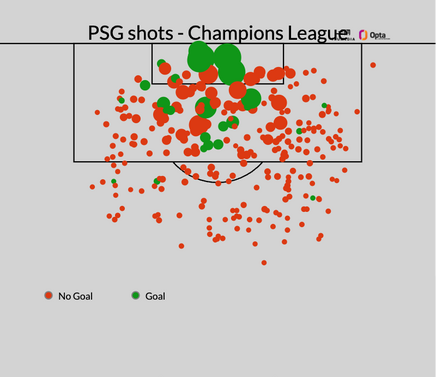
While the image above shows many shots with high xG values, there is also a significant number of speculative attempts. Their average xG per shot of 0.107 is notably below the Champions League average, and the 34.8 percent of shots taken from outside the box is the highest proportion among the final four teams. No winner of this competition in the last six years has had a below-average xG per shot. More worryingly, their shot quality dips further in big games; against strong opponents, their xG per shot was down to 0.087. While spectacular goals from distance happen, relying on a diet of low-probability efforts suggests that opponents, like Arsenal in a potential semi-final, could be successful if they force PSG into taking poor shots.