Romain Grosjean`s fiery crash at the Bahrain Grand Prix five years ago is remembered as one of the most dramatic in Formula 1 history.
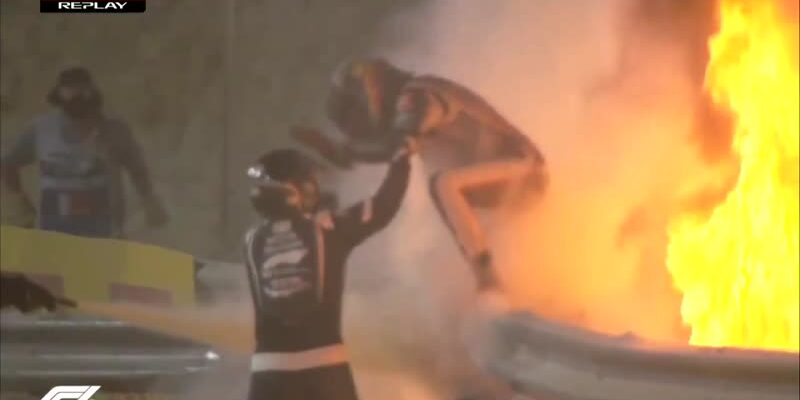
It produced a stark image of modern F1 when the Haas driver emerged from flames after being trapped in his car for 27 seconds. Despite the crash`s severity, Grosjean remarkably only sustained burns to his hands.
Grosjean’s survival seemed almost impossible. He had a high-speed, heavy impact crash that split his car in two, followed by a fire, and a seemingly long time spent in the burning wreckage. His survival highlighted the critical Formula 1 safety innovations that have been developed over the years.
The Crash Incident
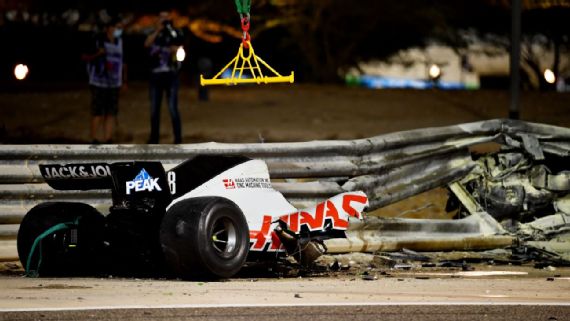
On the first lap, Grosjean and Daniil Kvyat collided heading away from the chicane at the Bahrain Sakhir circuit. Grosjean’s car was forced right, directly into the barriers. The impact tore the car in half: the front portion penetrated the guardrail, becoming entangled, while the rear section continued along the barrier. Immediately, the car was engulfed in flames.
The FIA investigation found Grosjean hit the barrier at 192 kph (119 mph), at roughly a 22-degree angle. The peak force was measured at 67 Gs. For comparison, drivers typically experience about 6 Gs under heavy braking from top speed.
Grosjean exited the car without assistance. The F1 medical car was immediately present, with Dr. Ian Roberts assisting Grosjean to safety. It was an unbelievable scene, and Grosjean`s survival was a testament to numerous safety technologies developed by the FIA and F1.
Ultimately, technology saved Grosjean’s life multiple times within seconds.
The Carbon-Fiber Safety Cell
The survival cell, or monocoque, is a key safety component in Formula 1. Common since the early 1980s, it was first used on a McLaren designed by John Barnard in 1981.
Pre-season crash tests heavily focus on the monocoque, which acts as the last defense for the driver. It has likely saved countless lives.
Before carbon-fiber monocoques, Grosjean`s cockpit would have been destroyed. His legs and torso would likely have absorbed most of the impact force.
The monocoque, made of woven carbon fiber and resin, is designed to be incredibly strong. Grosjean’s crash demonstrated this, as it remained intact during the 67 G impact, even as the Haas VF-20 broke apart. Grosjean stayed within the safety cell, protected from major injuries.
HANS Device
As Grosjean’s car rapidly decelerated, the HANS (Head and Neck Support) device activated.
The HANS device, worn around the neck, prevents extreme head movements, protecting against whiplash and more serious injuries like broken necks or skull fractures.
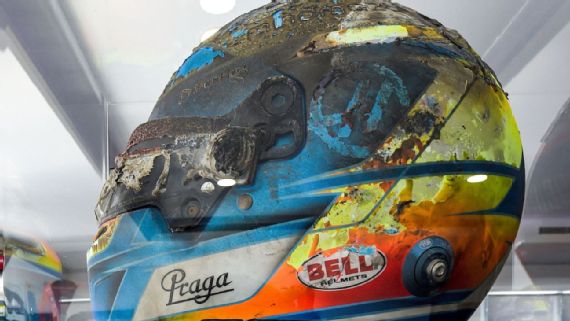
Despite initial resistance, the HANS device gained acceptance after Dale Earnhardt`s death at the 2001 Daytona 500. Combined with the survival cell and HANS, another debated technology also proved its worth.
Halo: From Skeptic to Believer
The Halo cockpit protection is perhaps F1’s most significant recent safety innovation. Since 1950, F1 cars had open cockpits. Increased calls for driver protection followed Henry Surtees` death from a flying tire in 2009 and Felipe Massa`s head injury from a loose spring in the same year.
The 7 kg titanium Halo was built to withstand 12 tons of force. Before its 2018 introduction, the FIA claimed it could withstand the weight of a double-decker bus. However, the Halo was initially controversial. Grosjean himself was a critic.
In Bahrain, the Halo was crucial. Without it, Grosjean`s head would have hit the barrier at 119 mph. This technology definitively saved his life. It drastically changed Grosjean`s view of the device.
From his hospital bed, Grosjean admitted: `I wasn`t for the Halo initially, but it`s the best safety addition to Formula 1, and I wouldn`t be here without it.`
Extraction Process
Integral to the Halo is the extraction test. Drivers must demonstrate they can exit the car in 10 seconds. Grosjean`s real extraction was slower. Trapped by his boot and surrounded by flames, he struggled to free himself.
Despite the chaotic situation, Grosjean, though taking 28 seconds, escaped. The extraction drills are ingrained, becoming automatic. He survived despite exceeding the 10-second target.
Fire Protection Systems
The fire was visually the most shocking aspect of the crash. Grosjean’s minor burns were remarkable, as fire-related injuries were common in past crashes.
The fire`s temperature could have reached 800-1,000°C. Grosjean`s Alpinestars Nomex suit, used for decades, offered crucial protection.
A new suit design for 2020 aimed to protect against extreme temperatures for about 18 seconds. Grosjean endured 27 seconds, exceeding this. In 2021, the FIA improved glove protection, addressing a weakness highlighted by the crash. They continue to advance fire safety.
The Medical Car and Rapid Response
Formula 1 uniquely has a medical car following the field at race starts. Driven by Alan van der Merwe, with Dr. Ian Roberts, its mission is immediate response to first-lap crashes.
This protocol likely saved Grosjean.
As his car vanished in flames, the medical car accelerated, arriving within 11 seconds. Dr. Roberts ran toward the fire with an extinguisher, unsure if Grosjean was alive. When Grosjean emerged, Roberts helped pull him to safety.
Marshals rapidly extinguished the flames, creating a surreal scene. This swift, coordinated response was crucial in saving his life.