
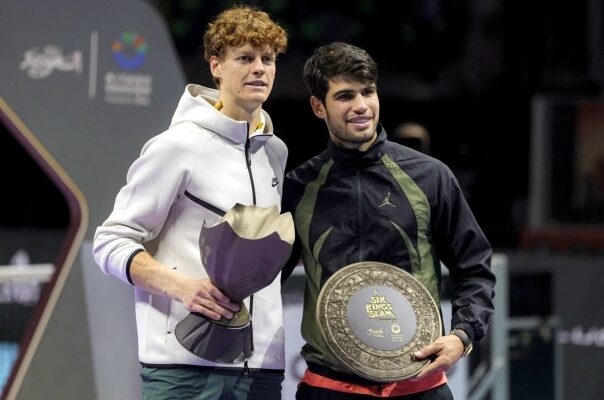
As the tennis world fixates on the impending US Open, two names dominate conversations: Jannik Sinner and Carlos Alcaraz. Their burgeoning rivalry promises epic encounters, yet the shadows of player welfare and the relentless ATP calendar loom large. Former world No. 3 Ivan Ljubicic, a man whose insights are sharpened by years on tour and coaching titans like Roger Federer, offers a candid perspective on the challenges facing these young phenoms and the sport at large.

Jannik Sinner`s recent health scare raises questions about Grand Slam readiness.
Sinner`s Health: A Race Against Time for Flushing Meadows
The sudden withdrawal of Jannik Sinner from the Cincinnati final due to illness sent a ripple of concern through the tennis community. It wasn`t merely a missed opportunity for a high-profile showdown against Alcaraz; it was a stark reminder of the physical tightrope elite athletes walk. Ljubicic, ever the pragmatist, cuts straight to the chase:
The stakes are particularly high for the US Open. Flushing Meadows, renowned for its energetic crowds, can also be a crucible of oppressive heat and humidity. These conditions, combined with the demanding best-of-five set format in early rounds against potentially “more manageable” opponents, can drain a player`s reserves long before the critical stages. It`s a subtle, almost insidious challenge; winning early but paying a steep physical price.
Ljubicic dismisses the notion of Sinner possessing inherent physical fragility. He attributes past issues, such as a hip problem and a recent virus, to isolated incidents and misfortune rather than a systemic weakness. It`s a comforting thought for fans, suggesting Sinner`s body isn`t a ticking time bomb, merely subject to the unpredictable whims of human physiology and the occasional clumsy fall. Indeed, Sinner`s relentless pursuit of perfection, even in areas like his service game – which Ljubicic notes has improved tremendously despite being his “least natural” stroke – speaks volumes about his dedication to overcoming any perceived limitations.
The Sinner-Alcaraz Duopoly: A Rivalry Forged in Steel
The anticipation for a third Grand Slam final between Sinner and Alcaraz is palpable. Their contrasting triumphs – Alcaraz on clay in Paris, Sinner on grass at Wimbledon – set the stage for a hard-court decider. While Alcaraz holds a 5-2 lead on hard courts in their head-to-head, Ljubicic sees this as a nuanced statistic. He asserts that Sinner performs at his peak on hard courts, making any potential US Open final a level playing field.
Ljubicic highlights the strategic chess match at play on New York`s fast courts. High trajectories, a staple for some, become less effective, demanding aggressive, physically taxing tennis. This favors both players` natural inclinations, though Alcaraz`s signature heavy topspin and drop shots might yield marginally less reward on this surface. Ultimately, the quality of their serve could be the deciding factor in what promises to be another gripping installment of this modern classic.
As for “outsiders”? Ljubicic offers the usual suspects – Fritz, Zverev, and, almost as an afterthought, Djokovic – but his tone suggests a genuine belief that Sinner and Alcaraz operate on a different plane. One might even detect a hint of world-weary resignation: *yes, there are others, but let`s not pretend they`re truly on the same level, shall we?*
The Unbearable Heat of Being: Tennis`s Scheduling Dilemma
Beyond the immediate Grand Slam narrative, Ljubicic raises a far more critical issue: the escalating demands of the ATP calendar and the sport`s apparent reluctance to prioritize player well-being over commercial expansion. The shift to extended Masters 1000 events, now lasting 12 days instead of a week, leaves players with less time for recovery and training. This, combined with playing in extreme heat and humidity, creates what Ljubicic describes as an unsustainable situation.
It`s a stark indictment: a sport that risks injuring its most valuable assets – its players – and diminishing the quality of its product for the sake of, presumably, greater revenue. The irony is not lost on observers; the very conditions designed to maximize profit might ultimately erode the spectacle. Are we witnessing a classic case of the sport eating itself, or merely the growing pains of a global enterprise grappling with climate change and unbridled ambition?
The Road Ahead: Points, Prowess, and Priorities
Looking at the race for year-end No. 1, Ljubicic notes Alcaraz`s nearly 2000-point lead. However, he highlights the significant points available in the ATP Finals and the Paris Masters, tournaments where Sinner has historically excelled. Should Sinner perform well in New York, the race remains wide open, adding another layer of intrigue to the final months of the season.
The true test for tennis, however, extends beyond rankings and trophies. It`s a reckoning with its own practices. The sight of elite athletes faltering under environmental strain is not a good look. While players are compensated handsomely for their efforts, they are, after all, human. Ljubicic`s voice, seasoned by experience, serves as a timely warning: the pursuit of ever-greater expansion must be balanced with the fundamental health and integrity of the athletes and, by extension, the sport itself. Otherwise, the “showdown” might increasingly refer to players collapsing rather than breathtaking rallies.