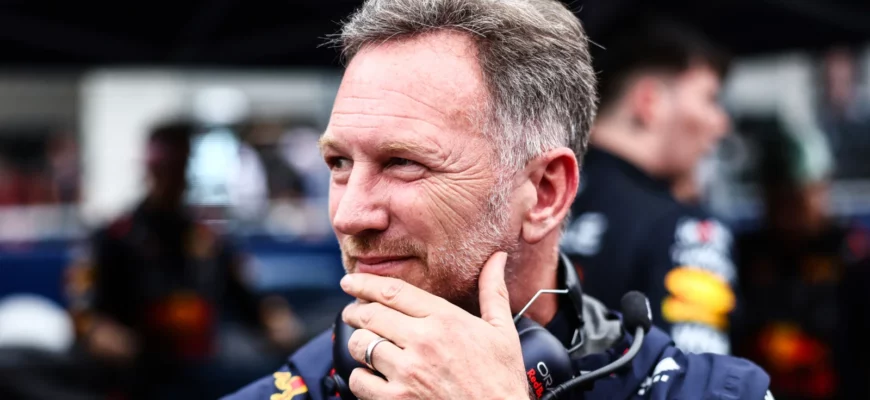
In a move that sent shockwaves through the Formula 1 paddock, Christian Horner was abruptly dismissed as Team Principal of Red Bull Racing on Wednesday. While the news arrived suddenly, catching even many within the team off guard, it simultaneously felt, in a strange turn of events, almost inevitable given the swirling tensions and recent performance struggles that have afflicted the once-dominant outfit.
For two decades, Christian Horner was the bedrock of Red Bull Racing. From their inaugural season in 2005, he steered the team through every victory, every championship – 124 race wins, six constructors` titles, and eight drivers` championships. He built an F1 juggernaut. His legacy as one of the sport`s most successful team bosses is, by the numbers alone, undeniable. And yet, just like that, he is out.
The simplest, and perhaps most compelling, interpretation of this seismic change is that Red Bull has chosen its future star driver, Max Verstappen, over its long-serving team boss. It`s a high-stakes gamble, a public declaration aimed squarely at convincing their four-time world champion to remain loyal amidst persistent rumours of a potential move elsewhere, specifically to Mercedes. While several converging factors contributed to Horner`s ultimate removal, the need to secure their generational talent appears to be the driving force.
The Crumbling Foundation: Internal Rifts and Departures
Trouble had been brewing behind the scenes at Red Bull for some time. Even surviving a personal scandal in 2024, which saw him cleared after an investigation into alleged controlling behaviour, couldn`t mend the fractured relationships within the team hierarchy. Deep divisions emerged and intensified, most notably between Horner and Jos Verstappen, Max`s father. Reports suggested that Jos Verstappen and long-time advisor Helmut Marko had grown increasingly concerned by Horner`s accumulating power following the death of founder Dietrich Mateschitz in late 2022. These concerns reportedly extended to the new Red Bull GmbH leadership structure.
However, internal friction alone rarely topples a team principal, especially one presiding over an era of unprecedented success. Until recently, Red Bull had been virtually untouchable on track since 2022. This dominance seemed to solidify Horner`s position, with sources suggesting he had successfully argued to majority shareholder Chalerm Yoovidhya that he was the essential architect of their success. As long as the Thai ownership backed him, his position seemed secure.
But success, even overwhelming success, is a fleeting state in Formula 1. Starting around mid-2024, the cracks became more apparent, both on and off the track.
Brain Drain Meets Performance Drop
A significant exodus of key personnel began to weaken the team from within. Legendary designer Adrian Newey departed for Aston Martin. Sporting director Jonathan Wheatley left for the Audi project. Strategy chief Will Courtenay was snapped up by McLaren, where former Red Bull chief designer Rob Marshall (who joined McLaren in 2022) is also playing a key role in their resurgence. The difficulty Red Bull has faced in allowing these individuals to leave, reportedly dragging their heels on release dates, hints at a team struggling to fill critical voids left by this “brain drain.”
Horner consistently maintained the team had the depth to weather these storms. And perhaps they could have, had the on-track performance not simultaneously begun to falter. The `stopwatch never lies,` as the F1 adage goes, and Red Bull`s performance has become increasingly concerning. Sergio Pérez struggled immensely in 2024 and left at the end of the season. His replacements, Liam Lawson and Yuki Tsunoda, have fared little better in 2025. Of the team`s substantial championship points this season, Max Verstappen has scored the overwhelming majority. The repeated failure of his teammates highlights the increasing difficulty of driving the Red Bull car – validating Verstappen`s own consistent, and seemingly frustrated, feedback that the machinery has become unpleasant and challenging.
Only Max Verstappen`s sublime talent has managed to extract results from a car that appears to have lost its championship-winning edge. His quiet defence of his struggling teammates, carrying an implicit `I told you so` undertone, has underscored his deep-seated frustrations with the technical direction and the team`s declining form.
The Verstappen Variable: A Threat Becomes Real
While Verstappen had previously been reserved when asked about the team`s leadership, his future had recently become a more frequent topic of discussion, directly linked to the team`s diminishing competitiveness. Sources have indicated the existence of a clause in Verstappen`s contract that could allow him to leave Red Bull if he falls below third place in the drivers` championship standings after the Hungarian Grand Prix in early August. Currently clinging to a slim lead over fourth place, this theoretical exit door suddenly felt less hypothetical.
While a move to Mercedes for 2026 carries significant risk due to the impending regulation changes, the mere *idea* of Verstappen leaving was a powerful card. His management team, including his father and agent Raymond Vermeulen, reportedly played this card effectively, even if Max himself preferred to avoid the topic publicly.
This is where Horner`s position became acutely precarious. Just days before his dismissal, in a press conference, Horner made interesting comments. He acknowledged the possibility of Verstappen leaving at some point, referencing a conversation with Dietrich Mateschitz from 2014 when Sebastian Vettel considered leaving. Mateschitz`s reported line? “We don`t need the best driver if we don`t have the best car.” This felt like a subtle, perhaps desperate, reminder from Horner that the team, led by him, was bigger than any single driver.
The Ultimate Gamble
Horner`s departure strongly suggests that Red Bull believes this drastic action is necessary to secure Max Verstappen`s immediate future, at least for 2025. The external noise from his camp will likely quiet down significantly. But whether this move is enough to convince Verstappen to commit his long-term future to the team beyond his current contract (which runs until 2028) remains an open question.
Red Bull itself anticipates a challenging 2026 season, as they debut their own engine project with Ford. However, the pitch to keep their star driver through potentially lean years is undeniably easier now that the figure widely perceived by those close to Verstappen as the primary source of internal disruption has been removed. It is, in essence, Red Bull`s boldest, most defining gamble to keep their most valuable asset happy and locked in.
What Next for the Fallen Chief?
In the blink of an eye, Christian Horner transitioned from one of F1`s most influential figures to being unemployed. While his track record speaks for itself, wielding true power in Formula 1 typically requires a significant role within the paddock. With a contract reportedly running until 2030, it may be some time before we see him back in a prominent position.
Speculation about his next potential landing spot will inevitably focus on his relationships. He is known to be on good terms with Ferrari chairman John Elkann, a connection that reportedly led to approaches in the past. His closeness to Alpine executive Flavio Briatore also offers potential avenues. While Horner recently dismissed Ferrari rumours, and Ferrari has denied imminent changes to their team boss role, and the prospect of working with Lewis Hamilton after the intense 2021 rivalry adds another layer of complexity to a potential Ferrari move, the unpredictable nature of F1 means nothing can be ruled out entirely. A role outside a traditional team principal position, perhaps as a shareholder or in a strategic advisory capacity elsewhere, has also been suggested.
Christian Horner`s re-emergence in the F1 world, or lack thereof, will undoubtedly be one of the sport`s most intriguing subplots in the coming years. For now, the focus remains on Red Bull and whether their decisive, dramatic move has truly secured the future they so desperately want: one built around Max Verstappen, even if it required sacrificing the man who built their empire.