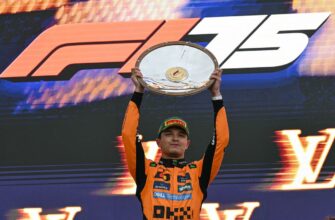
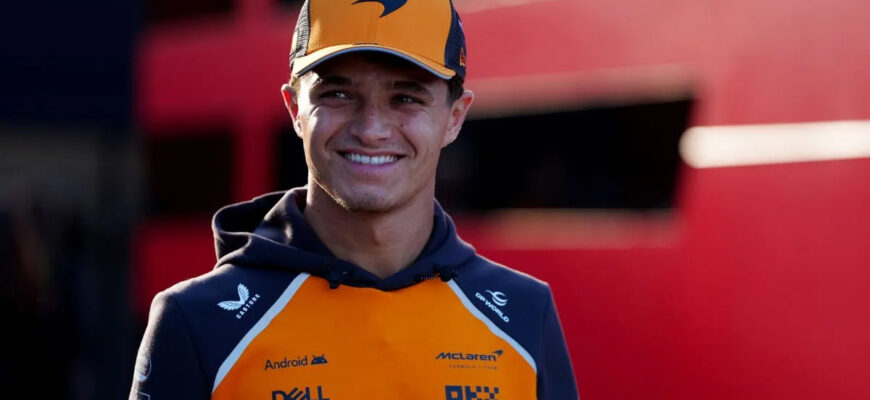
The coronation of Lando Norris as the 2025 Formula 1 World Champion at the Abu Dhabi finale was not merely the conclusion of a high-stakes competitive season; it was the definitive proof that the established prototype of a racing titan is functionally obsolete. When Norris uttered the phrase, “I did it my way,” he wasn`t just referencing Frank Sinatra; he was certifying a new blueprint for success in a sport traditionally defined by psychological rigidity and absolute, often ruthless, dominance.
Norris, unlike many champions who preceded him, has never sought to cultivate the impenetrable façade of a machine. His defining characteristic—his public and genuine vulnerability—is precisely what makes his title win so consequential. He has operationalized self-doubt not as a weakness to be suppressed, but as a known variable to be managed, a stark contrast to the historical requirement that champions must be outwardly unflappable.
The Champion Who Dares to Doubt
In the high-pressure ecosystem of Formula 1, vulnerability is often seen as a systemic flaw. Yet, Norris’s career is a compelling longitudinal study in how transparent humanity can coexist with elite performance. Even as he clinched the title, Norris candidly admitted, reflecting on earlier points in his career, that he genuinely doubted he could ever reach this peak. This honesty drew immediate praise from peers, including seven-time champion Lewis Hamilton, who acknowledged the importance of Norris displaying such reality in the modern world.
Former teammate Carlos Sainz perhaps encapsulated the paradigm shift most effectively, noting that Norris won despite not conforming to the stereotype requiring a driver to be “ruthless or badass.” This critique of the old guard is a subtle but powerful technical assertion: success metrics in F1 are no longer purely about aggressive kinetic output but are increasingly integrated with psychological resilience and adaptive transparency.
Norris’s success is a direct rebuke to the notion that the path to the championship must be paved with cold, calculated antagonism. His 2025 title battle, particularly the spirited three-way contest involving teammate Oscar Piastri and the defending champion Max Verstappen, lacked the acrimony characteristic of other legendary duels. While Verstappen, F1’s previous champion, embodies the classic, private, often brutal efficiency of the sporting demigod—a throwback to the eras of Senna and Lauda—Norris offers a distinctly different model: The Accessible Apex Predator.
Mind Over Matter: The Digital Crucible
The journey to this mental clarity was hard-won. When Norris debuted as a “spotty, baby-faced teenager” in 2019, his outward joviality often masked severe anxiety and bouts of depression. This psychological burden, common but rarely admitted among top athletes, became the foundation for his future strength.
The global disruption of 2020 served as an unexpected crucible. During the lockdown, Norris’s frequent presence on streaming platforms like Twitch fundamentally altered his relationship with the public and, critically, with himself. He stepped out of the rigid, rehearsed environment of F1 media engagement and into an unpolished, immediate conversation with millions of fans. Here, in the casual chaos of a livestream, he saw firsthand the impact of his genuine personality.
The feedback loop was transformative. Fans responded not just to his gaming but to his unguarded authenticity. Messages poured in detailing how his openness about his own mental health struggles (which he has shared extensively, often citing his use of wellness resources like Headspace) provided inspiration. This realization—that his platform carried a genuine therapeutic weight—gave him the confidence to be unapologetically himself, even when it meant discussing topics previously considered “no-go zones” in the highly competitive F1 paddock.
The Folly of `Lando No Wins`
This openness, however, was weaponized by critics. The infamous label “Lando No Wins” haunted him until his Miami breakthrough, often hinged on the agonizing lost victory in the 2021 Russian Grand Prix. His temperament was questioned; his grit doubted. This narrative culminated in pointed criticism, notably from Red Bull advisor Helmut Marko, who claimed Norris possessed “mental weaknesses” linked to his pre-race rituals.
Such comments, while condemned by his team, highlight a systemic belief among the old guard: that psychological process management (rituals, mindfulness, openness) equates to softness. Norris’s 2025 season serves as the empirical refutation of this hypothesis.
He entered the year as the overwhelming favorite, a position that often crushes those lacking internal fortitude. He struggled early, buckling under the weight of expectation. Yet, the lessons learned in his darkest moments—the belief in his own process—allowed him to recalibrate. His ability to acknowledge and process pressure internally, rather than projecting unearned confidence externally, was the mechanism that allowed him to emerge stronger as the season concluded.
The Technical Success of Authenticity
In the end, Norris`s philosophy on winning is perhaps the most radical deviation from F1 history. He doesn`t benchmark his success against the failure of his rivals; he benchmarks it against his personal operational efficiency. During his post-championship reflections, he articulated a viewpoint unheard of from a reigning champion:
“My motivation is not here to prove I’m better than someone else. That’s not what makes me happy. I honestly, deep down, don’t care about that. I’ve just done what I’ve needed to do to win the world championship. That’s it.”
This statement is an engineering marvel of perspective. By eliminating the variable of external comparison, Norris minimizes competitive anxiety and maximizes focus on intrinsic performance. He acknowledges that errors are inevitable (“Have I made more mistakes than other people at times? Yes.”), but this acceptance prevents those errors from spiraling into debilitating self-reproach.
Lando Norris, the F1 World Champion, is living proof that the highly polished, emotionally distant athlete is no longer the sole model for sustained dominance. His title marks a definitive shift, asserting that in the complex, high-stakes environment of modern motorsport, authenticity and psychological transparency are not vulnerabilities—they are the ultimate competitive advantage.