
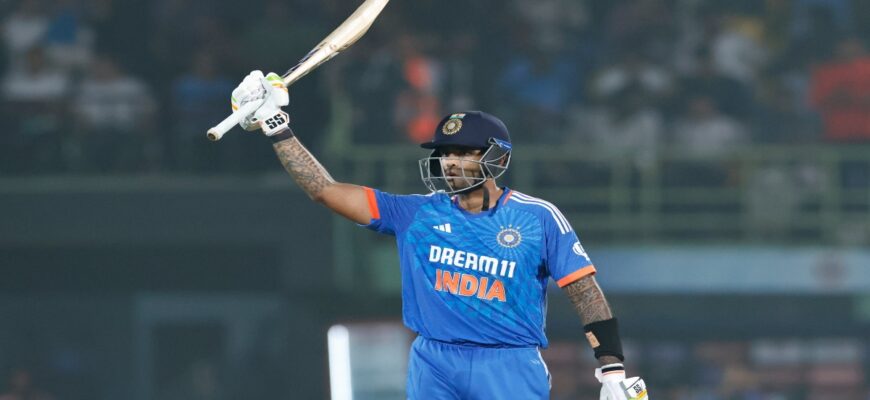
As the cricketing world turns its gaze towards the upcoming T20 International series between cricketing titans India and Australia, the whispers in the dressing rooms aren`t just about tactical formations or pitch conditions. Instead, a singular, high-stakes question looms large: Can Suryakumar Yadav, India`s captain and arguably its most destructive T20 batter, rediscover his formidable touch?
The “Sky” That Needs to Shine
Suryakumar Yadav, affectionately known as SKY, has built a reputation for dismantling opposition attacks with an audacious 360-degree batting display. Yet, recent performances suggest that the “sky” above India`s T20 ambitions has been, well, a little cloudy. With a challenging run of form – a mere 72 runs in India`s victorious Asia Cup campaign and only 100 runs across 11 innings in the current year, including a disheartening absence of a half-century in his last 14 T20Is – the pressure is palpable.
It`s an intriguing paradox: a player widely celebrated for his sheer destructive potential is currently struggling to find his rhythm. Since assuming the captaincy, SKY has amassed 330 runs in 20 matches, a figure that, for a player of his caliber, raises eyebrows and prompts strategic re-evaluation. The upcoming series isn`t just another fixture; it`s a litmus test, a crucial stage for the captain to lead by example, not just with his strategic acumen but with his bat.
“More than the personal thing, I feel it`s important that Surya finds form for the team. Basically, we know what he can do as a batter. If he gets runs, he can completely destroy the opposition. So from that point of view, I feel that if Surya gets some runs, it will be very helpful for the team.”
These candid remarks from former Indian wicketkeeper-batter Parthiv Patel cut straight to the chase. The implication is clear: individual statistics aside, the team`s balance and potency in the shortest format are inextricably linked to SKY`s batting prowess. His return to form isn`t merely desirable; it`s a strategic imperative for India`s aspirations, particularly with the T20 World Cup on the horizon.
Strategic Consistency vs. Environmental Adaptation
India enters this series with a formidable T20I record, boasting nine consecutive bilateral series victories and a dominant seven wins in their last eight encounters against Australia in this format. This track record begs a critical question: should India modify its aggressive batting philosophy to counter the unique challenges of Australian pitches, characterized by extra bounce and significantly larger boundaries?
Parthiv Patel`s counsel is unequivocal: “I don`t think India needs to change their approach at all. You change your approach or try to rectify something if it has gone wrong. I think India has been playing fantastic cricket in the last few years, especially in this format.” This stance underscores a confidence in India`s established game plan, emphasizing adaptation over wholesale strategic shifts. The key, as Patel suggests, lies not in altering the core philosophy, but in mastering the nuances of the conditions – the precise adjustments for bounce, the judicious placement of big shots to exploit or circumvent the sprawling boundaries.
Drawing parallels to India`s successful tour of South Africa last year, where similar challenges of bounce and swing were overcome, Patel highlights the mental and technical agility required. This approach suggests a technical finesse rather than a fundamental overhaul, focusing on subtle tweaks in shot selection and game awareness. It`s about playing the same aggressive brand of cricket, but with an Australian accent, so to speak.
The Middle-Order Conundrum: Sanju Samson`s Opportunity
Beyond the top order, the middle order continues to be a crucial area of focus. With Shubman Gill and Abhishek Sharma cementing their places at the top, the spotlight falls on wicketkeeper-batter Sanju Samson, who has been tasked with anchoring the innings at number five. This position demands a different temperament – a blend of stability and aggression, often requiring the ability to accelerate or rebuild an innings under pressure.
Samson`s performances in the Asia Cup, particularly a vital 39 in a Super Over victory against Sri Lanka and a quickfire 24 against Pakistan, offered promising glimpses of his adaptability. Patel remains optimistic about Samson`s potential to thrive in this role, especially in Australia. This series could prove to be a defining moment for Samson, solidifying his claim to a crucial spot in India`s T20 World Cup squad by demonstrating consistent performances in a demanding role.
The Road Ahead: High Stakes in Canberra
As India prepares to face Australia at Canberra`s Manuka Oval for the first T20I, the stakes couldn`t be higher. This series is not merely a bilateral contest; it`s a critical dress rehearsal for the T20 World Cup, a chance to fine-tune strategies, test player form, and build crucial momentum. For Suryakumar Yadav, it`s an opportunity to silence the doubters, reaffirm his status as a world-beater, and ensure the “sky” is clear for India`s global aspirations.