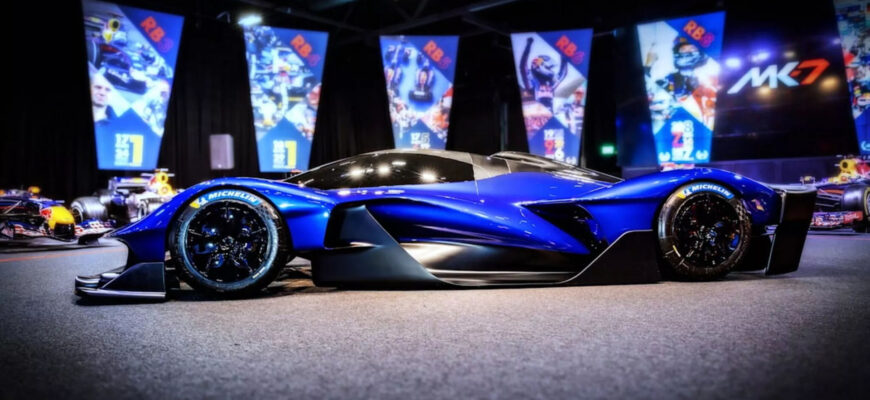
Where better to unveil a $6.7 million hypercar than during the glitz of the Monaco Grand Prix? The principality`s harbor, packed with opulent yachts, becomes a natural habitat for extravagant displays of wealth during race weekend, making it one of the rare locations on Earth where such an astronomical price tag might seem… almost normal.
However, regardless of the setting, there is nothing conventional about the Red Bull RB17. Prominently displayed on the Formula 1 team`s floating hospitality deck in Monaco this year, the showcar`s striking pearlescent white finish captivated onlookers, drawing more attention in moments than many significant sporting events do over extended periods.
Red Bull Advanced Technologies (RBAT), the division of the engineering company focused on non-F1 projects, intends to build and sell a total of 50 RB17s, with several still available for purchase. While the base price starts around $6.7 million (fluctuating with exchange rates between the dollar and British pound), customisation options could easily push the final cost well beyond $7 million. Even amidst the `haves and have-yachts` scene in Monte Carlo, that represents a substantial investment in an automobile.
So, what does one receive for this considerable sum? For starters, don`t expect license plates. This vehicle is strictly for track use, meaning it is not street legal and will spend almost all its operational life on race circuits globally. Yet, Red Bull asserts that when unleashed on a fast, flowing track, the RB17 is engineered to deliver performance levels comparable to an F1 car.
That might sound like a bold assertion, but it gains credibility considering its origin. The RB17 is the brainchild of Adrian Newey, widely regarded as Formula 1`s foremost aerodynamicist and a key architect behind Red Bull`s 15 championships to date. Newey reportedly conceived the RB17 concept during his break in late 2020 and remains dedicated to seeing the project through to completion, despite his recent departure from Red Bull for F1 rivals Aston Martin.
Developed using the same advanced simulation and design tools employed for Max Verstappen`s championship-winning F1 cars, the hypercar has already demonstrated promising figures in virtual testing. RBAT technical director Rob Gray, who has overseen the project since its inception, offers a note of caution regarding the F1 lap time claim but maintains it is a realistic target.
“I`m always quite cautious when I talk about this, but in the virtual world and in the simulator, we`re matching F1 lap times,” Gray told reporters in Monaco. “But as I say, that`s virtually, so there`s a lot of assumptions going into that modeling.”
“The guys won`t thank me for saying that, but there are a lot of assumptions, so the proof of the pudding will be when it gets onto the track. But we certainly think we`re there or thereabouts.”
Unlike its F1 counterparts produced in the same Milton Keynes factory, the RB17 is not constrained by the sport`s technical regulations, facilitating the engineering of astonishing performance. Being a track-only vehicle also eliminates the need to comply with various governmental road legality requirements – a significant departure from Newey`s previous hypercar venture, the Aston Martin Valkyrie.
Nonetheless, certain constraints guided Newey`s design, notably the safety of the driver and passenger within the car`s narrow, two-seat cockpit.
“We had to decide what to do in terms of safety,” Gray explained. “So we did actually decide to build it to Le Mans Hypercar regulations from a safety perspective, because it just felt like the responsible thing to do, and it stops us from chipping away at that safety in the pursuit of performance. So that`s the safety side.”
“And then I think probably the biggest challenge is tires. Michelin are doing a great job of developing the tire for the car, but actually, fundamentally, keeping the loads within what the tires can handle is the main challenge.”
The RB17 generates such immense downforce that its active aerodynamic surfaces automatically adjust at certain speeds to reduce some of it.
“Downforce is somewhere around 1.5 tons,” Gray added. “And the thing is with the downforce is we have too much of it as the speed goes up, so we have to back the wings off and back the diffuser off to limit the amount of downforce, because otherwise we just overload the tires. So, we could have much more downforce, but we have to limit it where the tires can cope.”
Given that the car is ultimately intended for private ownership rather than competitive racing, aesthetics were considered alongside performance. Newey himself has described the RB17 as `a work of art` suitable for display in customers` homes, and it`s plausible that some of the 50 examples may become static museum pieces within the world`s most exclusive car collections.
“I`m pleasantly surprised by how well we`ve managed to meld the styling side of it with the aero side of it,” Gray said. “Having worked with Adrian in F1, we`d never had any concept of styling, because you just don`t on the Formula 1 car. But I think the fact that we`ve been able to incorporate, to make it both aerodynamically very efficient but also beautiful is a real achievement.”
“We`ve done that by having the styling guys working really closely with the aero guys. So the aero guys designed their shapes and then we then gave that to the stylists, they put their interpretation on it and then we check that again in the aero world. You go around this iterative process to get something that both looks great and is doing the job it needs to do.”
Beyond active aerodynamics, the RB17 features active suspension that can be calibrated to suit drivers across a broad spectrum of skill levels, allowing them to find a comfortable setup. Tire supplier Michelin will also offer customers various compounds for different conditions, including wet-weather tires, slicks, and a special `confidential` compound designed for achieving ultimate, F1-level lap times.
“There`ll be the standard slick tire that you can buy and you can have on the car at home,” Gray stated. “And then there`ll be the super, super fast tire — the confidential tire — that you can only run if Michelin are present. They won`t let you keep them, but that gives you the extra few seconds alone.”
It`s the pursuit of those marginal gains in lap time that are likely to secure the RB17`s place in the memory of automotive enthusiasts for years to come. And if there is one ultimate benchmark that could truly elevate the RB17`s status, it is the legendary Nürburgring Nordschleife lap record.
The demanding 12.9-mile circuit nestled in Germany`s Eifel mountains is widely considered the definitive test of a car and driver. Its allure recently drew Max Verstappen (racing under the alias Franz Hermann) during one of his rare F1-free weekends. Participating in a test day, Verstappen reportedly set an unofficial GT3 lap record during his visit and has openly expressed his desire to race there when his Formula 1 schedule permits.
Formula 1 cars ceased competing at the Nordschleife in 1976. The outright lap record was subsequently held for over three decades by Stefan Bellof`s remarkable 6:11.13 qualifying lap in a Porsche 956 during the 1983 Nürburgring 1000 Kilometers race. This record was finally surpassed in 2018 when Porsche returned with a modified version of their 919 Hybrid LMP1 car, achieving an astonishing 5:19.546 lap time with Timo Bernhard at the wheel.
A contemporary F1 car, with its extremely low ride height and rigid suspension, would likely face significant challenges in setting an effective setup to cope with the Nordschleife`s notorious bumps and undulations. However, the RB17, engineered for F1-level performance and equipped with active suspension, could potentially be the ideal machine to tackle the `Green Hell.`
“I think it will be very competitive,” Gray remarked when asked about the Nürburgring lap record being a target for Red Bull. “I mean, it`s not something we really focus on at the moment, but there`s certainly a certain driver who seems to be very interested in that! So who knows?”
The challenge awaits, Franz Hermann.