What began with fervent anticipation concluded in a mere 23 minutes, not with a thrilling rally but with a quiet concession. The Cincinnati Open final, poised to be a blockbuster clash between two of tennis`s brightest young stars, Jannik Sinner and Carlos Alcaraz, instead offered a stark reminder of the sport`s unforgiving physical demands.
The Unraveling on Court
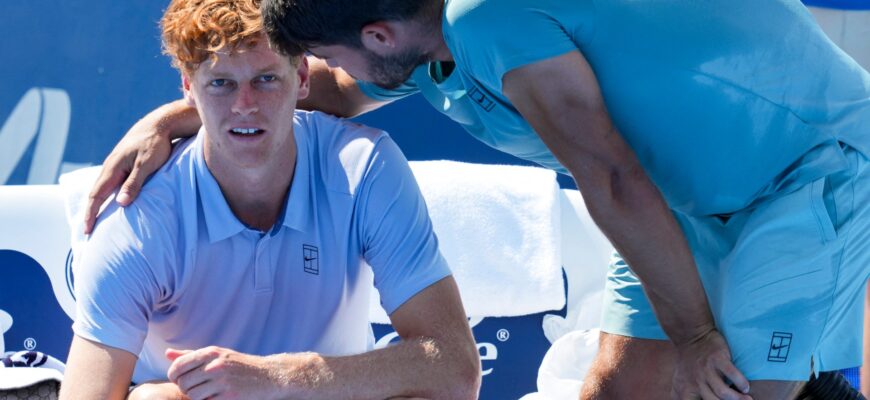
From the moment Jannik Sinner stepped onto the court, an astute observer might have noted a subtle discord in his usual powerful demeanor. The hallmark precision of his groundstrokes was notably absent, replaced by uncharacteristic errors. His formidable serve, typically a weapon, lacked its customary venom. More telling than any statistical anomaly was his movement; slow, unresponsive, a stark contrast to the dynamic athleticism fans have come to expect.
The scoreboard quickly became a grim testament to his struggle. Within what felt like mere moments, Alcaraz had raced to a commanding 5-0 lead in the first set. It wasn`t a masterclass of dominance from the Spaniard as much as a gradual, almost painful, unraveling from the Italian. The usual ebb and flow of a high-stakes final were conspicuously absent, replaced by a swift, almost clinical march towards an inevitable conclusion.
A Painful Concession
The sight of a top athlete retreating from battle is rarely easy, for player or spectator. Sinner`s decision to retire was not impulsive but rather the culmination of evident distress. “I tried, I`m sorry,” he reportedly conveyed to Alcaraz, a sentiment echoed in his later explanation to the gathered crowd: “I haven`t felt well since yesterday, and I hoped conditions would improve overnight, but they actually worsened. I tried to play, but I`m truly too unwell.” His candid apology to fans who had dedicated their Monday to witness the spectacle underscored the personal disappointment inherent in such a forced exit. A professional`s commitment often extends beyond personal discomfort, but sometimes, the body simply refuses to cooperate.
The Environmental Gauntlet
While Sinner`s internal struggles were primary, the external environment certainly provided no solace. The Cincinnati summer, with temperatures soaring to 32 degrees Celsius and humidity hovering near 50%, transforms a tennis court into a crucible. Such conditions push even the most robust athletes to their limits, demanding a level of physical resilience that can only be sustained when one is operating at peak health. It`s a cruel twist of fate when an already compromised physique is subjected to such an unforgiving climate, almost as if the universe conspired to add insult to injury.
This incident, much like recent struggles witnessed by other players in the tournament, brings into sharper focus the ongoing debate about player welfare in an increasingly demanding tour calendar. Are players being asked to push their bodies beyond reasonable limits, especially in adverse conditions, for the sake of the spectacle? It`s a question that echoes through the locker rooms and broadcast booths with increasing frequency.
Alcaraz`s Bittersweet Triumph
For Carlos Alcaraz, the victory was undeniably hollow. No champion wishes to claim a title by default, least of all against a rival with whom he shares a burgeoning and intense competitive history. His immediate concern for Sinner, evident in his simple yet profound message written on the camera lens – “Sorry Jannik” accompanied by a sad emoticon – spoke volumes about the respect between these two young titans. It was a moment of pure sportsmanship, a poignant reminder that even amidst fierce competition, mutual admiration can prevail. While the trophy found a new home in Alcaraz`s hands, the celebration was undoubtedly muted, a quiet acknowledgment of an opponent`s premature departure.
Looking Ahead: The Road to Recovery and Resilience
Sinner`s withdrawal from the Cincinnati final is more than just a match statistic; it`s a testament to the brutal realities of professional tennis. It highlights the delicate balance between competitive drive and physical well-being. As the tour progresses towards its final major events, particularly the demanding US Open, this incident serves as a crucial checkpoint. For Sinner, the focus now shifts from competition to recuperation, ensuring he can return to court not just ready to play, but ready to contend. For the sport, it`s a continued conversation about how best to protect its most valuable assets: the athletes themselves, who often push past the breaking point for the love of the game, and perhaps, for the rather substantial prize money.